
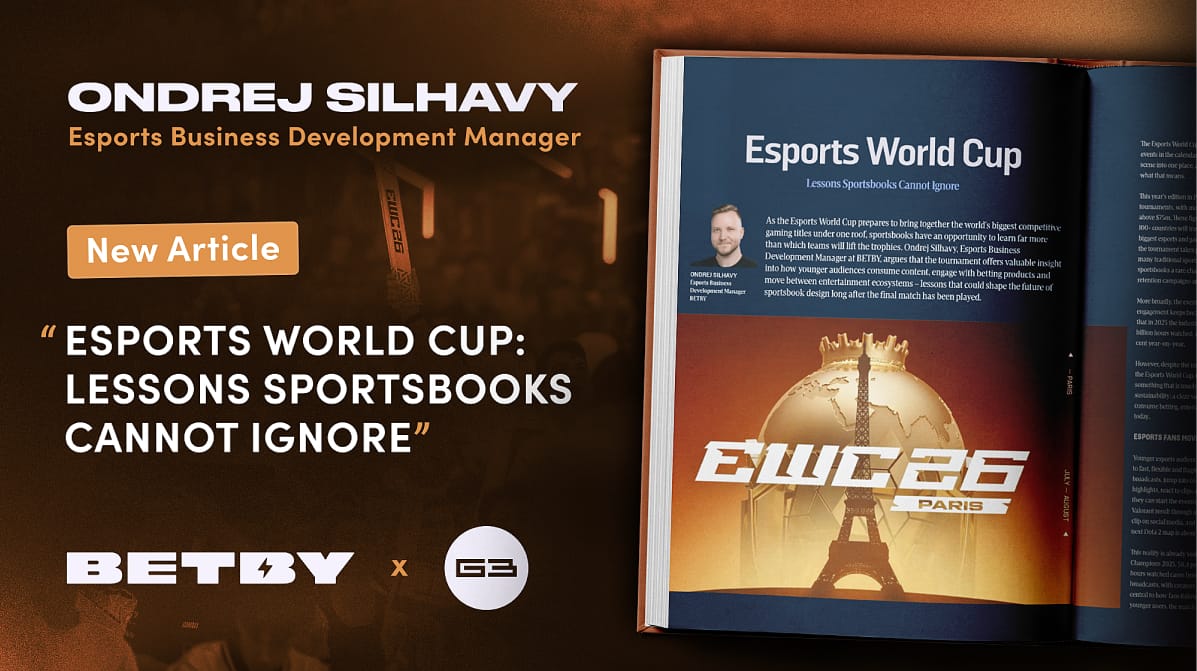
As the Esports World Cup prepares to bring together the world's biggest competitive gaming titles under one roof, sportsbooks have an opportunity to learn far more than which teams will lift the trophies. Ondrej Silhavy, Esports Business Development Manager at BETBY, argues that the tournament offers valuable insight into how younger audiences consume content, engage with betting products and move between entertainment ecosystems — lessons that could shape the future of sportsbook design long after the final match has been played.
The Esports World Cup is already one of the biggest sportsbook events in the calendar because it brings the whole esports scene into one place, and operators should not underestimate what that means.
This year's edition in Paris will gather 24 games across 25 tournaments, with more than 2,000 players and a prize pool above $75m. These figures, along with the fact that fans from 100+ countries will travel to France to attend the world's biggest esports and gaming event, speak for themselves. Plus, the tournament takes place during the summer period, when many traditional sports calendars are quieter, giving sportsbooks a rare chance to build major acquisition and retention campaigns around esports.
More broadly, the event also comes at a time when esports engagement keeps breaking records. Esports Charts reported that in 2025 the industry reached a new all-time high of 3.3 billion hours watched, excluding mainland China, up 1.5% year-on-year.
However, despite the important betting volume expected from the Esports World Cup, the tournament will offer operators something that is much more valuable for their long-term sustainability: a clear view on how younger audiences consume betting, entertainment and competitive gaming today.
ESPORTS FANS MOVE DIFFERENTLY
Younger esports audiences — especially Gen Z users — are used to fast, flexible and fragmented content. They watch official broadcasts, jump into co-streams, follow creators, consume highlights, react to clips and move between titles. This means they can start the evening with Counter-Strike, check a Valorant result through a creator, watch a League of Legends clip on social media, and then open a sportsbook because the next Dota 2 map is about to start.
This reality is already visible in major tournaments. At Valorant Champions 2025, 58.4% of the event's 47.58 million hours watched came from co-streamers rather than official broadcasts, with creators such as FNS and Tarik becoming central to how fans followed the competition. For many younger users, the match is only one part of the experience.
ESPORTS BETTING AND THE GEN Z FRONTIER
The rise of short-form entertainment has changed how users expect digital products to feel, and sportsbooks are not immune to that shift. For instance, YouTube Shorts alone has passed 70 billion daily views, which says a lot about the pace of modern content consumption.
The creator, the community, the chat and the surrounding content are all part of the same journey. The conclusion for sportsbooks is clear: esports users need a different type of UX compared to what most platforms offer today.
Take one simple example. In traditional sports, the rhythm is easier to predict: there are established matchdays, familiar leagues and well-known betting habits. Nonetheless, esports is more dynamic because matches usually happen across time zones, formats change from title to title, and communities behave differently depending on the game and region.
A CIS Dota 2 bettor, a Brazilian Counter-Strike fan, a Southeast Asian Mobile Legends supporter and a European Valorant viewer may all fall under the esports category, but their expectations are very different.
And once operators understand that, the next question becomes product design: how do you build a sportsbook experience for users who are used to constant movement, instant context and entertainment that never really stops?
SHORTER FORMATS & MORE TOUCHPOINTS
The rise of short-form entertainment has changed how users expect digital products to feel, and sportsbooks are not immune to that shift. For instance, YouTube Shorts alone has passed 70 billion daily views, which says a lot about the pace of modern content consumption.
That said, not every product needs to be reduced to a few seconds in order to succeed. The bigger point is that users expect action, clarity and speed instead of spending too long figuring out what a market means, when the next map starts, or why a certain bet is relevant, meaning the experience has to be immediate.
This reflects why short-form esports content is becoming so powerful nowadays. For example, in BETBY's award-winning proprietary esports feed, Betby.Games, most matches last around 2 or 3 minutes, creating fast betting cycles and frequent settlements. From an operator perspective, this solves a very practical challenge: what happens between the big EWC matches, during off-hours, or when the live calendar slows down?
In those gaps, users are still online, but they need relevant content to stay engaged. Short-form solutions keep the sportsbook active without waiting for the next major fixture, benefiting both users and operators.
At the same time, speed only works when users understand what they are betting on, and that's where context becomes just as important as content volume.
CONTEXT MATTERS AS MUCH AS COVERAGE
Full coverage of the Esports World Cup across pre-match and live markets is essential, especially for the biggest titles such as Counter-Strike, League of Legends, Dota 2 and Valorant. But coverage alone does not create a strong esports product, far from it.
Esports bettors need context such as statistics, streams, widgets and simple product flows that help them understand what is happening in real time — all within the same platform. This is especially important because every title has its own logic. For instance, Counter-Strike is built around maps, economy and momentum. League of Legends has objectives, draft strength and scaling. Dota 2 has hero timings, Roshan control and late-game volatility. Valorant has agent composition, pistol rounds and map-specific tendencies.
A football bettor can understand a corner or a yellow card immediately no matter the league or match, while an esports bettor may need more support if they are moving from one title to another during a multi-game event. That support needs to come through AI-powered market presentation, in-depth statistics or integrated streams. This is also why BETBY was the first provider to introduce Betting Tips for a broad range of esports titles, using data-driven insights to give users more context before they place a bet.
One of the biggest lessons from working closely with operators is that esports performance improves when the platform helps users feel confident instead of simply adding more markets. Once that confidence is there, operators can then focus on relevance, because esports may be global, but betting behaviour is always local.
LOCAL RELEVANCE IS KEY
This is visible in regions that have a strong connection to specific titles, such as Brazil, which has a deep Counter-Strike culture. For example, in Q3 2025, Brazilian creator Gaules was the number one Counter-Strike streamer by total watch time and the only CS creator to exceed 10 million hours watched, which shows how strongly one local creator can shape engagement around a global title.
The same regional logic applies elsewhere. Southeast Asia is extremely strong for mobile esports, while Eastern Europe and CIS markets have long-standing Dota 2 communities.
The rise of mobile esports also proves how regional habits can become global forces. Before last year's Honor of Kings World Championship Grand Final in China, tickets sold out in just 2 seconds, showing the level of demand that mobile-first esports can generate when the product matches the audience. In fact, these differences should influence what operators promote, how they schedule campaigns and which products they place in front of users.
The same thinking applies to the reasoning behind Betby.Games, which includes localised titles such as eKabaddi, eSumo, eVaquejada and eFootvolley. These work in specific countries or regions because they connect esports-style betting mechanics with cultural familiarity, making each game easier to understand when the user already recognises the sport, the pace or the visual language.
And customisation also plays a role here. Operators increasingly want control over in-game advertising, players, teams, margins and overall presentation, since it allows them to adapt the esports experience to their specific market instead of offering every audience the same product. Once again, BETBY offers exactly that, helping operators shape esports products around the habits, preferences and cultural references of their own players. That is ultimately the lesson operators should take from the upcoming Esports World Cup: esports users can recognise when a product has been built with their world in mind, and just as quickly when it has not.

For the original article ➡️ click here